Friday, March 16, 2012

Two Days in Hong Kong


Queen Elizaeth in Hong Kong

Star Ferry

At 6:30 AM, on March 14, we are sliding into the harbor. We were in Hong Kong only 10 years ago, and there are even more high-rise buildings now. We are docked at Ocean Terminal, on the edge of the Kowloon waterfront. We exit the boat through a four-story mall, and then it is only a 5 minute walk to the Star Ferry. We could not be better located.


Walled Home
Single Clan Home

Our first day in Hong Kong is a busy one. We leave early in the morning for the New Territories. We visited the New Territories in 1967 - while Hong Know was still a British colony. The area had been acquired by the British to provide agricultural support to Hong Kong. It was a rural, undeveloped area at the time. Now it is high-rise buildings, highways, tunnels, and light industry. A few of the old buildings are still there, and we visit them. They are walled “homes” for large families - one is the Sam Tung UK Museum, and another is a walled city belonging to one clan (now a set of small dingy apartments).


Bamboo Woods Temple
Four Faced God
Large Buddhas

Coiled Incense


We visit a large Buddhist/Taoist temple, Bamboo Woods The site is a set of buildings, and stairways, with each temple overlooking the others. This temple complex has both the four faced god - from Thailand - as well as large indoor Buddhas. The culture seems to have melded Buddhism, Taoism, and Confucianism. One can buy coils of incense that can be hung in the temples, and which will burn for a month. The normal three incense sticks are there as well.

Fortune Sticks


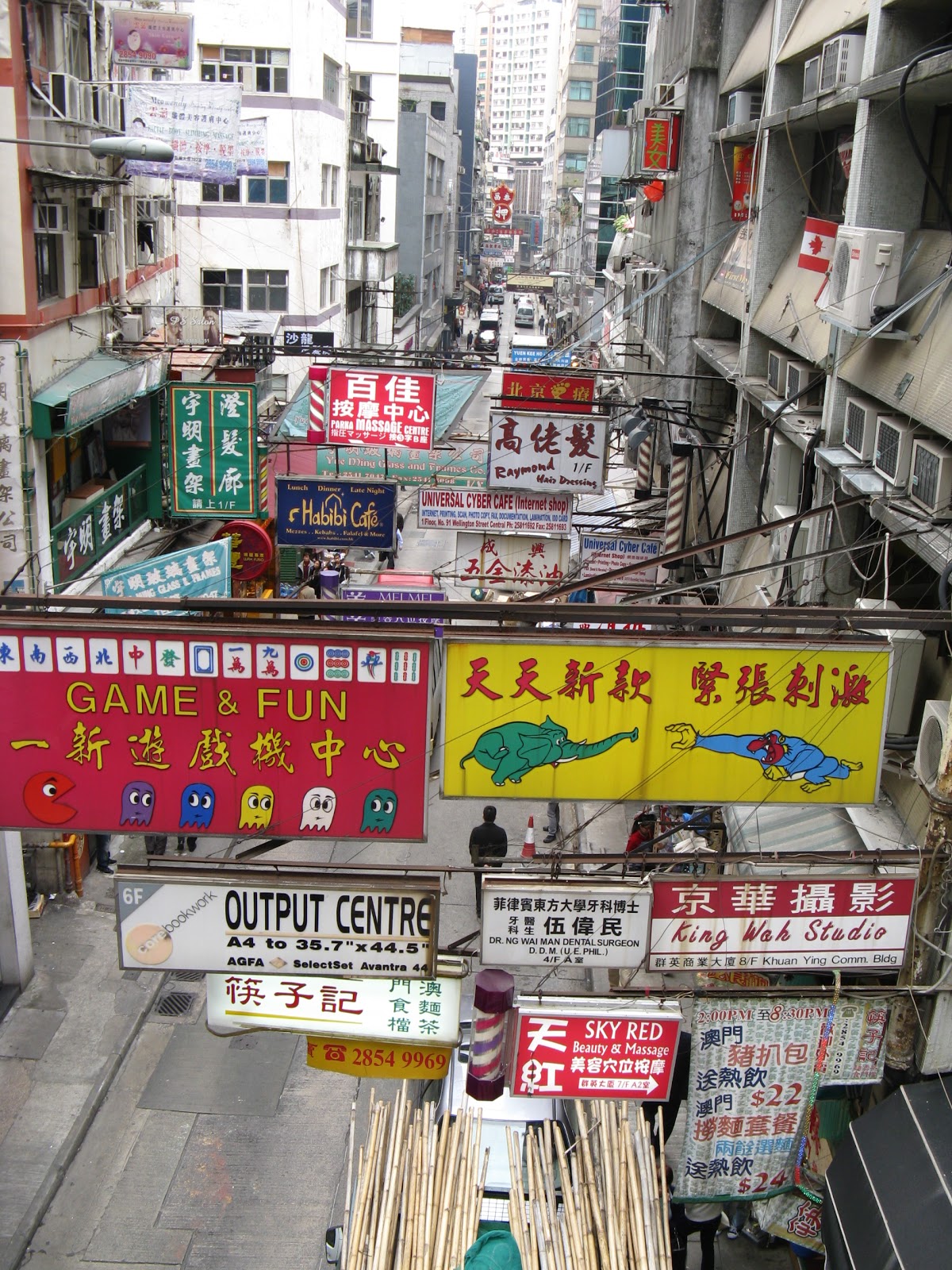
Busy Street Market Options


We return to the ship in time to have a few tea sandwiches, and then leave again at 4:30 PM for a Hong Kong by night tour. We first visit a busy street market, that extends for 8 blocks. One can purchase paintings, electronics, toys, crafts, clothes, food, and jewelry. Convenient money changers are available to convert U.S dollars to Hong Kong dollars.

Street Market

Peking Garden Dinner


Due to traffic, we arrive late to dinner at the famous Peking Garden for a northern Chinese banquet (eleven courses). The meal includes fancy cold cut combination, sautéed shrimp and scallops with vegetable, sautéed diced chicken with chili sauce, seafood soup, barbecued Peking duck, deep fried fillet of fish and pineapple, sautéed sliced beef with spring onion, braised Tientsin cabbage with minced ham, fried Peking noodles with shredded pork, steamed minced vegetable dumpling, and chilled sago cream and honeydew melon. We sit at a round table with dishes placed on a Lazy Susann in the middle. The quality of the food is excellent.

Symphony of Lights
Symphony of Lights 
Pearl of the Orient
Jean in the Fog
We rush from the restaurant to the Kowloon harbor-side for the 8:00 PM sound and light show, Symphony of Lights. Buildings along the harbor, on the Hong Kong Island side, are lit with fanciful and changing colors, and lasers flash from the top of buildings in a variety of colors. After the light show, we board the bus for a drive to Victoria Peak on Hong Kong Island. We use the tunnel under the harbor to reach the island. Since this is Spring in Hong Kong, mist is to be expected, and at the top of Victoria Peak we see only the fog. However, our guide is resourceful, and knows a stop half-way down the mountain where we can see Hong Kong island glowing below us - truly the Pearl of the Orient. We arrive back at the ship at 10:30 PM.

Avenue of the Stars
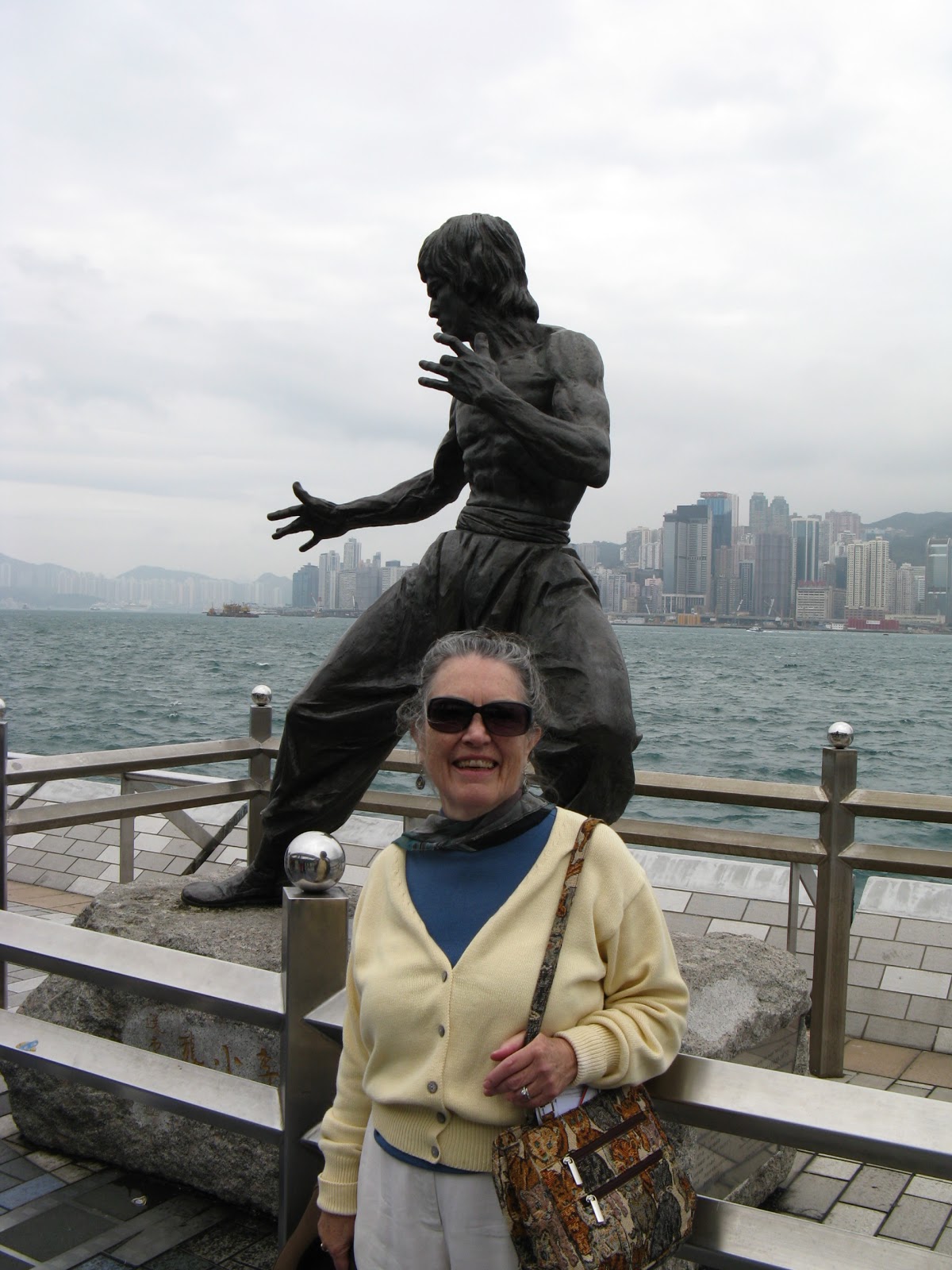
Jean and Bruce Lee
 

The next day we are on our own. We walk first to the “Avenue of Stars”, where the hand or foot prints of famous Chinese film stars are located in the pavement along a harbor-side walkway. From there we take the Star Ferry to Hong Kong Island. The ferry has operated for over a century, and it is the same as it was when we visited Hong Kong in the 60s. The rules now allow free passage for anyone over 65, whether a resident of Hong Kong or not.


View from the Walkway
View from the Escalator
Escalator on Hong Kong Island
From the Ferry Terminal, on the Hong Kong side, we follow a series of walkways which cross over the major roads in the central district. (There was a model of the city of the future at the 1940 World’s Fair that had walkways over all the streets - Hong Kong is almost like that). You can enter many of the shops and malls from the walkway level. We are searching for the escalator that goes up the hill. It is about 800 feet long - the longest in the world we have been told. We find it and ride up to several interesting districts on the side of the hill before we walk back down, and using the ferry, return to the ship. After a quick lunch, we go to the art museum, only to find it is closed on Thursdays. Next we try to book a table at Felix - a restaurant on top of the Peninsula Hotel. (We ate there 10 years ago, and loved it.) Sadly they are having a private party so we cannot repeat the experience. On the way back to the ship, Jean finds a bargain in beetle watches, and Sumner finds an allergy drug, in case he needs it. Finally we return to the ship to have dinner, watch the light show for a second time, and have a drink in the Commodore Club on the 9th level. We return to our room late, but stay awake to watch the ship sail out of Hong Kong harbor at 11:30 PM.

We are on our way to Viet Nam. Our next port is Chan May, the port for Hue and the Perfume River.

Sunday, March 11, 2012

Kota Kinabalu - Borneo

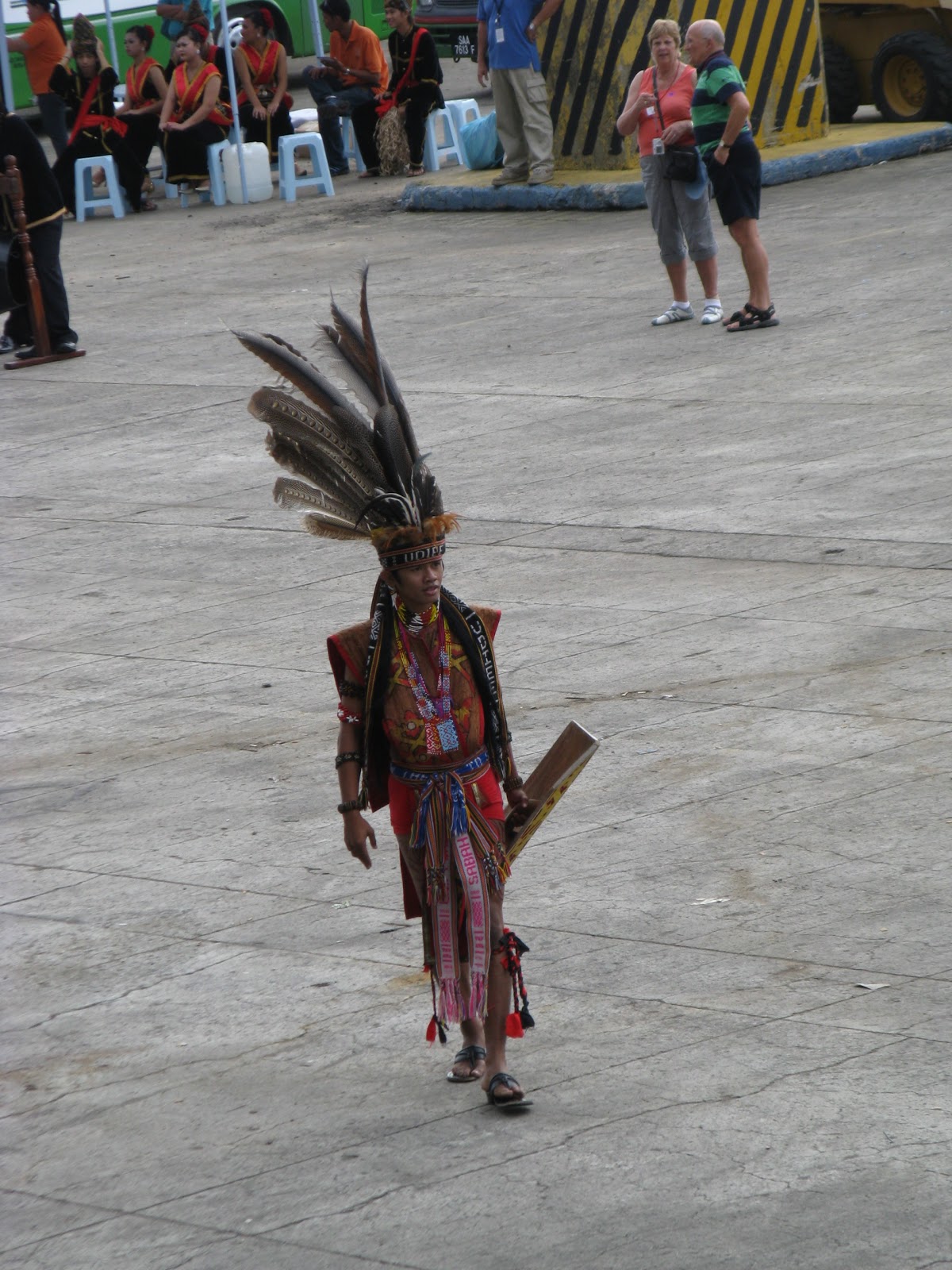
Greeting from a headhunter

We arrive at 8:00 AM in Kota Kinabalu, the capital of Sabah (originally North Borneo). We are met at the dock by costumed women who give us beaded necklaces, and costumed warriors (perhaps head-hunter impersonators) making grunting noises, waving spears and shields. The town was originally known as Jesselton. It has a few high-rise buildings, shopping malls, and light industry. A large mosque is on the outskirts, which can hold 5,000 worshippers. The country is officially Moslem - although there are actually more Christians than Muslims.


Mosque in Kota Kinabalu


Orchids on the Mountain


We board a bus, bound for Kinabalu - the highest mountain in Sabah - at 13,431 feet tall. It is Sunday, so traffic is relatively light - at least in the morning. We have over a two hour drive to reach the mountain, and the park which covers most of the mountain. The mountain can be climbed, usually in two days. No special equipment is needed, and there is a rest house half-way up the mountain where one can spend the night. The mountain attracts many Asian visitors, and the trip is like the trip up Mount Fuji in Japan. It’s a popular climb - and it must not be attempted in the rainy season (December - January). Reservations are often made six months in advance, especially around New Years.
In the Cloud Forest


Mount Kinabalu - Almost Seen
We have good luck with the weather - although cloudy, it doesn’t rain and the temperature stays below 80 degrees (unlike the weather in the port as we learn when we return.) The top of the mountain is in clouds - and seeing the mountain is like seeing Mt. McKinley in Alaska - requiring luck and timing. We take a 1 hour hike through the trails, and spend another hour in a reserved area. Most Orchids are not in bloom at this time of year, but we see several small ones, as well as some of the pitcher plants that trap small insects. We are told that some species of these plants can trap mountain rats, and hold two liters of water. We see few animals - and hear a few birds. Because there are few animals, most animals stay below this height - nothing to eat. This is a “cloud forest” - a tropical rain forest fed by moisture from the clouds.

In a Chinese Garden
After our adventures in the forest, we visit a hotel for a Chinese buffet - sweet corn crab soup, sweet and sour chicken, mushrooms, mixed vegetables, beef in a savory sauce, and fruit. The drive back to the ship has a brief stop at a pottery factory, and then we return to the ship about 4:30 PM.

On the bus, our guide provides insight into the history of Borneo, its politics, details of head-hunting, and marriage customs. Most people believe in some form of spirit worship as well as reincarnation. One’s soul goes to Mount Kinabalu where it will be judged.  There are other spirits (mostly in the head) which, with the proper ceremonies can be focused and committed to anything from growing rice to increasing harmony at home, or so the headhunter‘s believed.. We learn that home-brewed rice wine (important for weddings) is best if you discover maggots in the wine after three months - that means it is sweet enough to attract them - a good sign.

We sail at 5:30 PM - bound for Hong Kong in two days. We will be crossing the South China Sea. I sailed in the South China Sea when I was in the Air Force. We could reserve a sail boat at Subic naval base. That was 45 years ago. It’s good to be back.

Saturday, March 10, 2012

Going to Borneo - days at sea


Leaving the Great Barrier Reef, we have been working our way north west toward Borneo, and our next port, Kota Kinabalu. We have been sailing through the islands of Indonesia, and just west of the Philippines. Days at sea involve lectures on global warming, oceanography, fish of the coral reefs, and some insight into the BBC series Human Planet. There are also opportunities for wine tasting, and duplicate bridge. The weather has been in the high 80s, and generally sunny. There was another party for those of us on the full world cruise - drinks and hors d’oeuvres . The evenings provide entertainment - musicians, singers, dancers, and magicians in the Queen’s Court theater. After the show, there is an opportunity to dance in the Queen’s Room, the Yacht Club, or listen to a vocalist - piano player in the Commodore Club. We are getting some reading done as well. We are both enjoying a recent John Le Carre novel, Our Kind of Traitor.

Sumner, Jean, and friends from the cruise

 We have remembered to do our experiments on the Coriolis effect - whereby a mass moving in a rotating system experiences a force (the Coriolis force) acting perpendicular to the direction of motion and to the axis of rotation. This means that water flows down the drain in a different direction after you cross the equator. It’s true! We crossed the equator yesterday - coming back into the Northern hemisphere.

There are lots of Australians on the ship. They are a lively bunch - even some of the entertainers are from Australia. Cunard offered them a good package price, including airfare for the leg of the trip from Sydney to Hong Kong. They have reduced the average age of the guests traveling in the Queen Elizabeth by at least 10 years.

Monday, March 5, 2012

Port Douglas - March 5


What is the only living entity that can easily be seen from outer space? The Great Barrier Reef - consisting of living coral - it stretches 2,300 km along the coast of Australia. (Coral is an animal - or at least lots of little animals.) The reef is actually a maze of 2,900 reef systems. We are in Port Douglas this morning to allow those who wish to have close access to the reef and its ecology.

View of the Coral

Captain Cook explored this area in 1770, and afterward made several voyages here. We came through one of the gaps in the reef he found.. At sea level, one can see the sea breaking as one approaches the reef, but still be over 100 miles from the actual coast of Australia - thanks to the continental shelf. We sailed through Whitsunday strait, by Whitsunday Island, both named by Captain Cook. Through an error in their timekeeping, the island was actually discovered and named on a Monday - still a remarkable accomplishment. Many of the islands and bodies of water were named by Cook, and the names remain to this day.

Catamaran
Port Douglas is now considered an upscale resort - with a few nice hotels. It prospered briefly during the gold rush. The ship cannot dock - so we are tendered to shore, using the ship’s lifeboats. From here we board a catamaran for the hour and a half ride (75 Km) to a floating platform where we will spend the day. We arrive at Agincourt reef and the ribbon reefs at the edge of the Great Barrier Reef. The day is clear, sea calm, and the temperature is about 90 degrees.


Sumner in Lycra
There are about 350 of us from the ship that make the trip. The floating platform is two levels, with underwater viewing platforms, areas for snorkeling, docks for semi-submersible craft for additional viewing, and a helicopter for those who want an aerial view. After some hesitation, Sumner decided to try snorkeling. The equipment was provided by the company that took us to the reef. Lycra suits were available - which not only protect from the sun, but provide some protection against jelly fish. (Some can be serious enough to require hospitalization.) Sumner puttered around looking at the various kinds of coral (staghorn, brain, mushroom, plate) and the various kinds of colorful fish (think of Nemo) that live within the coral. Jean did a little wading and sitting in the water. We took the semi-submersible ride to see other areas of coral, and had a lunch, provided on the raft.


Puttering at the Reef


We returned to the ship in the late afternoon. We are continuing through the Great Barrier Reef - following routes that were originally established for sailing ships. Captain Bligh (after the events of Mutiny on the Bounty) sailed through this area in the ship’s launch, and eventually reached land. He became a governor of the penal colony in Australia some years later. In five more days we will reach our next port in Borneo.


Queen Elizabeth

We have been joined by many Australians, who boarded in Sidney, and in Queensland. Many will go as far as Hong Kong, and then exit the ship. The ship’s population is younger and more animated.

Friday, March 2, 2012

Brisbane, Australia March 2


We arrive in Moreton Bay at 3:30 AM, load the pilot, and are docked by 8:00 AM at Fisherman’s Island. Queen Elizabeth is too large to sail into Brisbine, as it would be unable to dock, or turn around in the river. As a result we are docked in a grain terminal - about 25 Km from the city. We are taking a tour this morning, so there is no need to take a shuttle bus into the city.


Our first stop is a koala sanctuary - which also has many of the other animals of Australia. Sumner has his picture taken with a Koala. The Koala’s name is Bart (or Burt) - hard to tell due to the Australian accent. They weigh about as much as our cat Tiger Lilly (who is rather ample for a cat). We spend time in a field of kangaroos - Jean actually pets one (although it would rather have been fed).


We are educated about kangaroos from our guide. A kangaroo when born is about the size of a human thumb. It is blind and hairless. When it comes out of the birth canal, it needs to crawl up the front and into the pouch. There it attaches itself to a nipple, and will stay attached. It will probably find another - 6 month old kangaroo in the pouch. The older kangaroo will go in and out of the pouch. The mother kangaroo manages to provide two different formulas for the offspring.

We watch an Australian sheep dog in action. Sheep dogs manage a flock of sheep from the front of  the animals. They should not nip at the heals. This is in contrast to dogs, who do nip the heals of the cows. Some of the animals in the sanctuary are difficult to see. We see the feet and part of the bill of a platypus, floating behind a log. There are lots of koalas. They eat eucalyptus leaves (but only certain varieties).  Because the leaves are toxic, they manage to process the moisture, and exude the toxin through their pores while they’re sleeping. They sleep most of the time, due to the toxins.


The temperature today is in the 90s, and it is good to return to the air-conditioned bus. We visit Coot-tha (one-tree) hill, for a view of the city. After that we get a tour of the city. Brisbane is a modern city, with very few old historical buildings. It has grown to a population of about 1.9 million people. Many high rise apartments and office buildings are in the city center.


It is 2:00 PM before the tour is over. We decide to return to the ship, rather than wander in the downtown in the heat and catch the shuttle back to the ship. We are quite thirsty when we get back - the bottles of water each of us took having been used up several hours earlier.  So we go up to the Garden Lounge, where we get some sandwiches (British tea sandwiches).  Jean has a half pint of beer and Sumner has a Mai Tai in memory of drinks we enjoyed when we were in the Philippines and Tokyo, years ago.  The ship should sail at 5:30 PM, once everyone has returned. We will have a two day run up the coast to Port Douglas and the Great Barrier Reef, our next port of call.

Wednesday, February 29, 2012

Sydney, Australia February 28-29

Sydney Opera Houaw


As in Auckland, we arrive in Sydney early - at 6:00 AM. This is necessary because of the ferry traffic during rush hours in the morning. The ferry traffic is the second busiest in the world, exceeded only by Hong Kong. The Queen Elizabeth is parked just across from the Opera House, in downtown Sydney.


Wombat
Penguin


We have rearranged our side-trips because Cunard is having a special dinner tonight (off the ship) for World Voyage travelers. We will be in Sydney for two days. The first day we leave early for the Blue Mountains. This trip takes us away from Sydney, into the spectacular landscape West of the city. Our first stop is the Featherdale Wildlife Park which houses most of the animals and birds native to Australia. In addition to Koalas (which are not bears as it turns out, but marsupials), there are wombats, Tasmanian Devils, Dingos, Kangaroos, Wallabies, Emus, and Penguins in addition to the variety of birds and lizards.


Kangroo with a "Joey"

The three sisters


From the wildlife park, we drive into the mountains - an area that has been compared to the Grand Canyon, to view the rock formations and vistas. Unlike the Grand Canyon, the floor of the valley is actually rain forest, so it is very dense and green down below. After viewing the rock formation called The Three Sisters (the name is based on an Aboriginal myth), we have lunch in a revolving restaurant. After that we take the world’s steepest perpendicular railway 700 feet down to the rain forest below. After walking on wooden platforms through the forest, we arrive at a cable car that takes us back to the top. Even with some traffic problems (accident on the highway), we are back at the ship in time to change to formal attire for our dinner at the town hall.


Sumner and Jean in the Blue Mountains

It is an impressive management of logistics - transporting 800 guests from the ship to the town hall, using a fleet of buses. The main reception hall is large enough for all of us, seated at 100 tables, with a large pipe organ taking up one complete wall at one end. Dinner and wine are served, and a 20 piece band with a singer entertains us during dinner (after the pipe organ, and a choir of little girls have finished). There is room for dancing as well. We are greeted by the head of Cunard - who has flown to Sydney to be with us. Clearly this is the way Cunard encourages customer loyalty.  We are amazed at the number of people who have taken multiple world cruses with Cunard - sometimes as many 8 to 10.


The next day we have a tour of Sydney. We are guided through the areas of the city, and out to Bondi beach - the closest beach for surfing to Sydney. After our tour, and a quick lunch in the Pub on the Queen, we walk through the Rocks - an area of Sydney close to the docks - that has preserved some of the old buildings and narrow streets.

This evening we will be transported to the Opera House for a performance of Puccini’s Turandot. The ship will sail at midnight, after we return. The production was impressive - as was the “new” ending to the opera - Puccini never lived to finish the opera.


About 1,000 people are coming and going from the Queen Elizabeth in Sydney. Many new faces on the ship. We learn that the first day in Sydney was the hottest they have had all year. Being in the Blue Mountains the first day meant that we experienced considerably cooler temperatures during the day. The second day was the wettest. We were glad to have our raincoats for our trip to the opera.  The ship sails at midnight from Sydney - a lovely harbor. We stay awake to watch. In two days we’ll be in Brisbane.

Melbourne, Australia


A day in Melbourne Australia


We arrive in Australia - a beautiful, sunny day. The first stop on our tour is the Shrine of Remembrance - a memorial to Australian and New Zealanders killed in World War I. Jean is particularly moved by the statue of a young man and his donkey, killed as they transported the wounded and dead away from the front lines. Often referred to as ANZAC - Australian and New Zealand Army Corps - the population of the two British Colonies were not large enough to support a single Corps on their own.


Our second stop is the tallest apartment building in the world - 92 stories tall. We are whisked to the 88th floor - called the Eureka Skydeck 88. We have a 360 degree view of the city. The ride to the top takes only 40 seconds. We can see the Queen Elizabeth in the harbor, and the Shrine of Remembrance we have just visited.


Captain Cook's Cottage
Tutor Village
Fairy tree detail
From the Eureka Center, we go to Fitzroy Gardens. Located within the extensive gardens is Cook’s cottage. The cottage, which actually belonged to Captain Cook’s parents, was dismantled stone by stone in the United Kingdom and rebuilt in Melbourne to honor the man who “discovered” Australia. Captain Cook never lived there - but he may have visited his parents when they lived there. The cottage seems small - but that is because part of the house was demolished in England to allow a highway to pass through. That was before they decided to make it a memorial and move it out of the country. Also in the gardens are a Victorian conservatory, a miniature Tutor village, and a fairy tree (with carvings of elves and fairies).


In another two days we will be in Sydney.