Friday, March 23, 2012

Ko Samui - a tour of the island


We have breakfast brought to the room, just to get a little more sleep before our tour for the day. We need to be tendered ashore, a half-hour ride, as the harbor is not deep enough for the ship to come closer. The island is small and compact - about 35 square kilometers - a little bigger than Shelter Island. (Located at the end of Long Island, where we have our Summer cottage.)


Our first stop is the temple of the Golden Buddha. The Buddha is reached by climbing 75 steps. He is bright gold, with a variety of temple buildings around the base of the hill. Around the Buddha is a shelter with a number of bells and wonderful views of the seashore. We ring bells with large sticks as we walk around the Buddha - bringing luck to ourselves, and to our friends at home. Normally you would have to take off your shoes to climb to the Buddha, but by 10:00 AM the tiles are already too hot for bare feet.


The next stop is a visit to the temple of the God of Mercy.  This is a much larger temple complex. There is a large multi-armed goddess, and a large laughing Buddha. The temple combines Hindu and Buddhist art. Our guide takes us to an indoor Buddha, with elaborate wall paintings, and tries in 10 minutes to give us the highlights of the life of Buddha.

Our bus continues around the island, stopping at “Beverly Hills” - an open-air wooden bar/restaurant so that we can have a drink (water, coke, or sprite). The coke can is barely recognizable, with “Coke” in Thai script. The language has three times as many vowels as English, and many more consonants. Our guide models the variations in saying “ma”, and I cannot recognize the subtle differences in sound and tone. The Thai script and language is totally different from Cambodian.


 Our last stop on the tour is a coconut plantation, to hear about how monkeys were trained to harvest coconuts. We meet the monkey, who demonstrates his skill at scaling the tree, and twisting off the coconuts so that they fall to the ground (watch your head). We learn how to open a coconut, grate a coconut, and how to make cream and milk from the coconut. Finally, we taste coconut on our way back to the ship.

Tomorrow is a day at sea - where I hope to catch-up on the blog’s entries. After that, we will be in Singapore the following day. We have already learned that Singapore is a fine city - you can be fined for anything from spitting, littering, jaywalking, etc. After Singapore there will be three more ports before we have a few days at sea. We have received a packet of information for our overland trip to the Taj Mahal. That is still 10 days in the future. Tonight will be a cocktail party with the captain and his staff (for world cruise travelers) before dinner.


Flight to Bangkok - return to the ship


Breakfast at 6:30 AM this morning - so we can make a morning flight to Bangkok at 9:50 AM. The flight is delayed a little, but we leave on Bangkok Air, “the boutique airline”.  For a 50 minute flight, they manage to provide us with a cold towel to refresh ourselves, and then a box with juice, water, and two small sandwiches. We meet our guide, and drive to the Mandarin Oriental Hotel for lunch. Traffic is practically grid lock - as we have to cross the river to reach the hotel.

Bangkok River
Lunch Buffet 
The lunch is elaborate - more than 50 Thai dishes, from delicate crab curry custards, to prawn lemongrass soup, fish in red chili sauce, deep fried mushrooms, and mango with sticky rice. Each dish has a Thai name, and some English translation. I finish the meal with fried banana in a sweet coconut milk.


Palace Buildings


After lunch, and more traffic, we arrive at the royal palace and temple of the Emerald Buddha. The palace is brightly colored, with towers and domes and many building


We take off our shoes to see the Buddha - he is dressed for Summer. His clothes are changed three times a year. The Buddha is not actually emerald, but green jasper. He is the most important Buddha in Thailand. Some of the buildings were built after the King’s visit to Europe, so they combine both European architecture and Thai in a single building.
Thai-European Architecture

Our Guide with pictures of the Emerald Buddha

The bus, which had dropped us off at the palace, is lost and delayed in the traffic. By the time it arrives to pick us up (another day of 98 degrees), we are too late for a scheduled shopping stop. We have at least a two hour drive to the port where the ship is docked. The traffic leaving Bangkok is moving at a glacial pace. We were scheduled to be back at the ship by 5:30 PM. We actually arrive close to 7:00 PM. Once we are aboard, the ship sails almost immediately. We have missed our normal seating (6:00 PM), not that we need to eat. In the end, we have a light meal on the Lido Deck - one of the other alternative dining venues. We shower and retire right after dinner - Our ship will be in Ko Samui the following morning. A Thai island that is developing as a beach resort destination.

Visiting Temples in Cambodia

Banteay Srey Temple


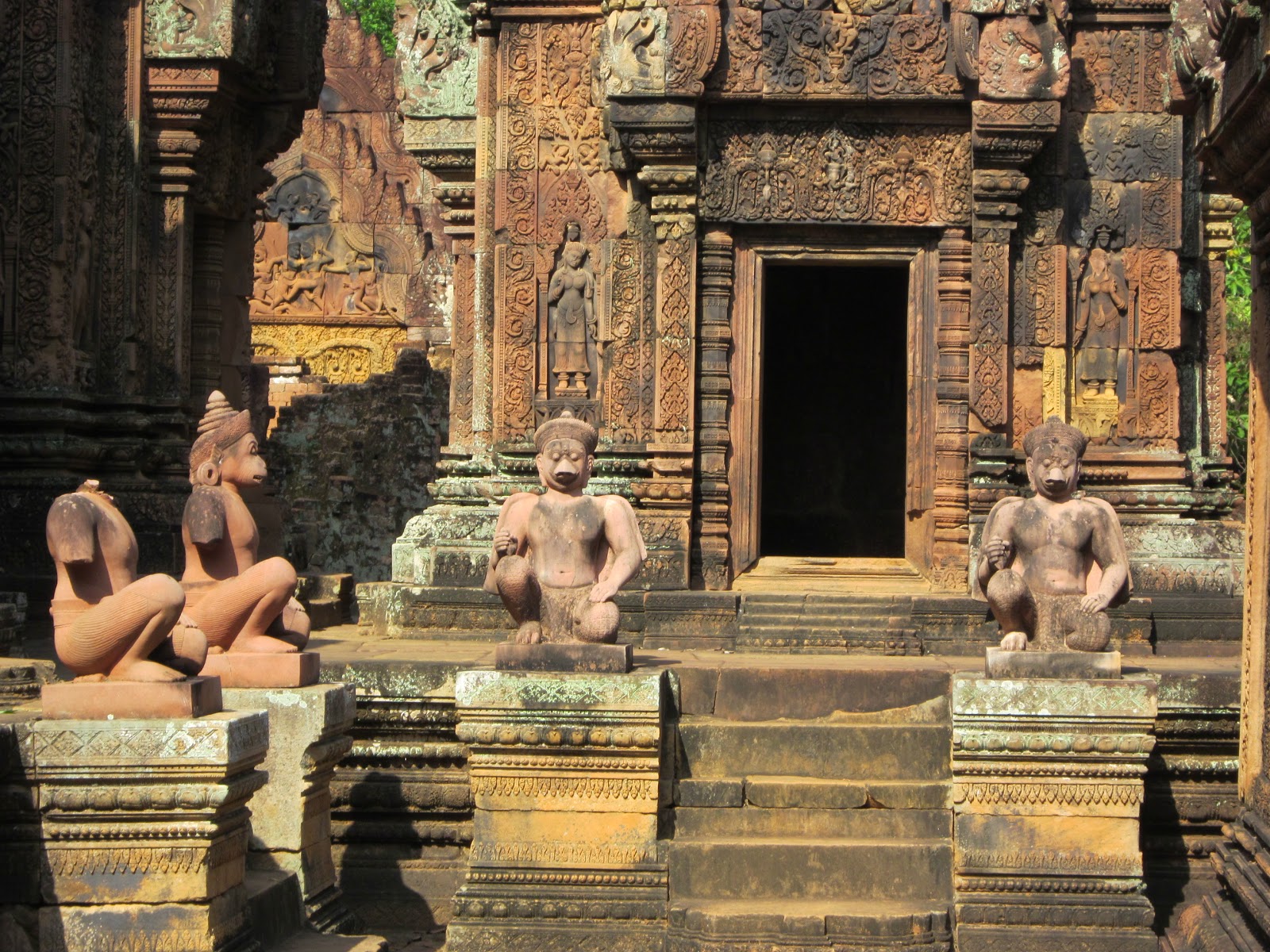
After a lovely buffet breakfast in the hotel, we leave for our visits to the temples in the area. The first temple is Banteay Srey, known as the Citadel of Women. The temple is an hour’s drive from the resort. Although a small temple, it has the most intricate and delicate carvings in the Angkor area. The temple looks almost pink, made of an especially hard sandstone - different from the sandstone at Angkor Wat. Pictures will be available when I can upload them - as the ship’s internet connection is too slow and unreliable.  As we leave the temple, we are entertained by local musicians, all of whom have lost limbs to land mines. It will be another 10 years before all the landmines have been removed. The horror of the time of Pol Pot is described by our guide, who lost his Grandparents during that regime. As a result, Cambodia has an especially young population.

Local Musicians - casualties of land mines

We drive an hour to visit Angkor Wat, The temple is massive, surrounded by a moat (now again filled with water), that is 1.3 by 1.5 Kilometers. We cross the causeway to enter the first courtyard. Like other temples in the area, this site has been carefully cleaned and reconstructed by archeologists (French in this case). After the site was abandoned 1,000 years ago, it became overgrown, and inhabited by bats. Bat guano more than a meter deep had to be cleaned away to reveal the stone of the temple. This is a Hindu temple, with massive wall carvings documenting the struggle between Vishnu and the Demon King. The courtyards and towers cover the entire area, one climbs high and higher to reach the central tower and inner chamber.  Hinduism and Buddhism coexist in the temple - when the next king became a Buddhist, the cross-shaped hall near the central court had a thousand Buddha images added to the ceiling.  The last tower is quite steep - Jean waits below as Sumner scales the last steps. The views are spectacular in all directions. Although the temperature is now 97 degrees, there is a breeze, and the central tower is open on all sides to a cooling breeze. We have lunch in the Tara Angkor Hotel - before continuing our day of temples.
The Entry Gate to Angkor Wat

Angkor Wat and its Moat
Jean waits in the shade


Central Towers of Angkor Wat

View from Tower to the Main Gate


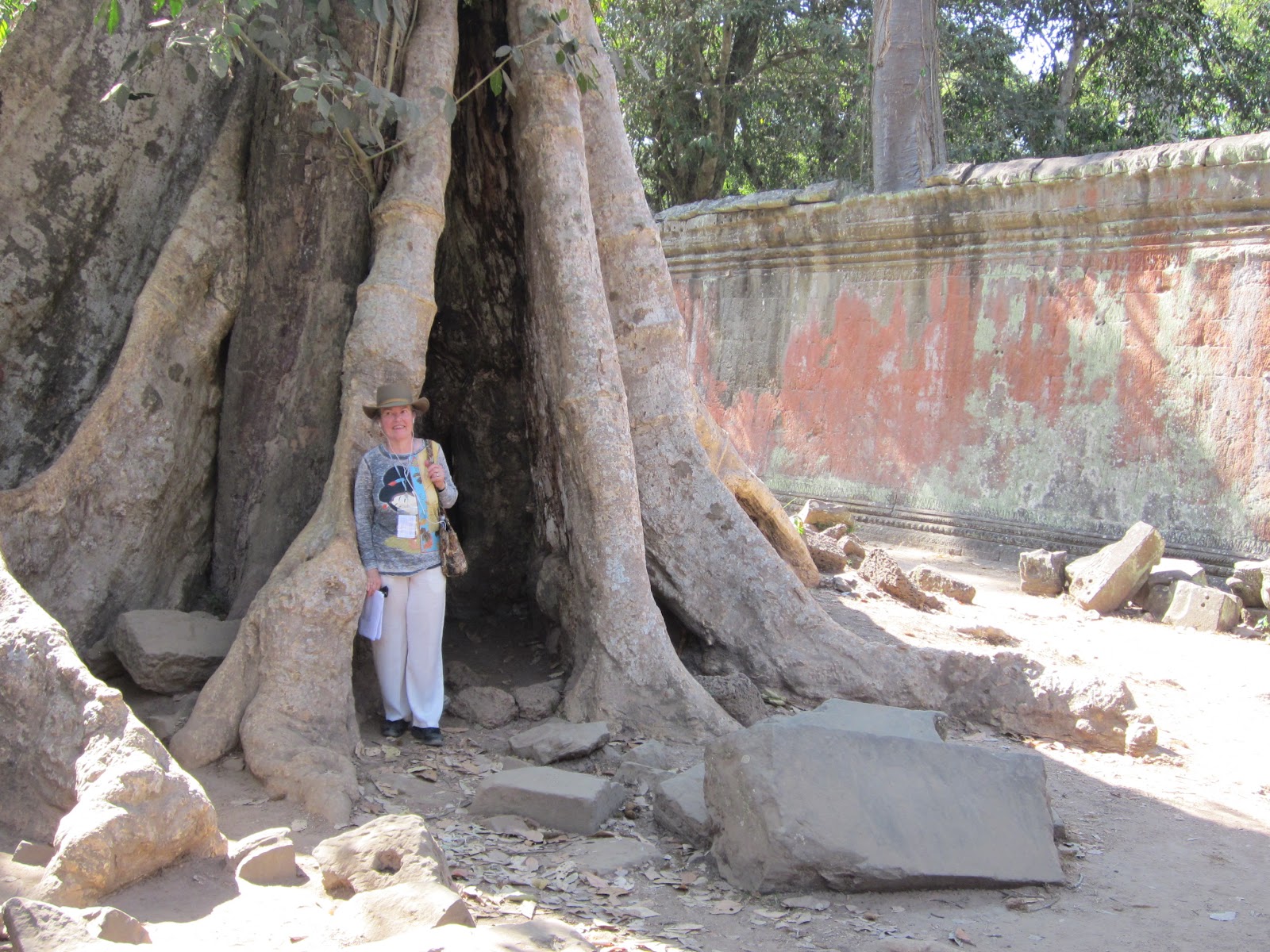
We visit the ancient city of Angkor Thom through the South Gate. The city has a large moat - and on the bridge into the city are 54 gods on one side, facing 54 demons on the other side of the bridge. Nine is a number with mystical properties so 54 is important (5+4=9). As it turns out, 54+54 = 108, and 1+8=9. How lucky and blessed can you be? Inside this ancient city wall are more temples (as well as families of monkeys).  We visit the Elephant Terrace, from which the Cambodian King blesses the rice harvest each year. At Bayon temple the towers have giant faces for Buddha, one of the most recognizable images of Khmer art and architecture. Finally we visit Ta Phrom, with its giant, tree-overgrown walls. This site was also used as the location for scenes in the movie Tomb Raider.

Gods at the Gates

Angkor Thom South Gate


Bayon Temple
Sumner Eyes the Buddha


Elephant Terrace

Sumner at Ta Phrom


Tree at Ta Phrom
Jean at Ta Phrom

Hotel Lobby

Evening Show at Hotel
Cast after the show
 We return hot, happy, and exhausted to the Sokah Ankgor resort - everyone needs a shower or bath. (Yes the bathrooms have tubs and large, separate showers). At 7:00 PM, there is an elaborate buffet setup for us by the pool. We are entertained by dancers performing traditional Cambodian dances.

 In the morning we will return to the airport to fly to Bangkok.


Saigon to Siem Reap - Vietnam and Cambodia


Saigon to Siem Reap - Vietnam and Cambodia

Jean and the First Course
The Final Course

 The night before our first overland trip, we have dinner in the Veranda Restaurant on the ship. We have a tasting menu, designed to showcase some of the better Chinese wines. The dinner is hosted by a trade sales manager who handles the export of the Chinese wines to London as well as throughout Asia. The wines are quite good, and designed to compete with French wines (so they will be quite costly if they ever come to the States). The “Chairman’s Reserve” has recently competed well in a blind taste-test against comparable French wines. The menu is excellent, six courses. This is the start of several days of over-the-top sightseeing and special meals. We return to our room to review the luggage we will be taking with us. After six weeks on the ship, we will be away for three days and two nights. We will be traveling with a group of 30 passengers from the ship.

Country of Motor Scooters
 
 The ship docks in Phu My, largely a container port some 45 kilometers from Ho Chi Minh City. It takes our group close to 2 hours to make the trip. The speed limit has been lowered to allow large vehicles like buses, automobiles, and trucks to share the same two-lane road with the hundreds of motor scooters.


Water Puppets
History Museum
Our guide assures us that citizens of southern Vietnam still call the city Saigon. Our first stop in Saigon is the historical museum. At the museum, we are treated to a water puppet show. The puppeteers stand behind a screen and manipulate the puppets that seem to dance on the water. The puppets include dragons, fairies, babies, and acrobats. After the puppet show, we stop for photos at Reunification Hall - the former Presidential Palace of South Vietnam - where the war was ended in 1975 as the South fell to the North. After that, we see a 300 year-old Chinese temple, this one honoring the goddess of the sea - since the Chinese came by boat. Next a stop at a lacquer ware factory before lunch.

Temple of the Sea Goddess

Ceramic Wall Details at Temple


Vietnamese Dancers
Town Hall
We have an extensive buffet at the Hotel Majestic while we are entertained by dancers, musicians, and singers - performing traditional Vietnamese pieces. After lunch we have photo stops at a number of French Colonial buildings - the City Hall, Notre Dame Cathedral, and the old post office. We stop at the Rex hotel to have Vietnamese coffee - a favorite watering hole for war reporters before the fall of Saigon. The bar is on the 5th floor of the Rex hotel - a rooftop with lovely views. Vietnamese coffee has condensed milk and ice added to the coffee. (Don’t dismiss it until you’ve tried it.) Soon its off to the airport for our flight to Cambodia.
Enjoying Vietnamese Coffee
Train Station


Notre Dame in Saigon


The flight is delayed, while they swap out airplanes, so it is after 6:00 PM before we are flying into Siem Reap in Cambodia. There is an enormous lake just south of the city, the largest fresh water lake in Southeast Asia. In the rainy season (fortunately already concluded), the lake expands to reach all the way to Phnom Penh. The trip by speedboat between the two cities would take 5 hours. We make the flight from Saigon to Siem Reap in less than an hour. The airport is new, with a terminal that looks like a resort hotel. The city is clearly preparing for a large increase in tourists. Already, many tourists come from Korea, Japan, and throughout Southeast Asia. We stay at the Sokha Angkor Resort, with large lovely rooms, several restaurants and bars, a saltwater swimming pool, and a friendly staff. The company handling our tour, performs the legwork with customs - obtaining Cambodian visas and other documentation. We have brought two passport pictures, necessary to complete the task.

Tomorrow we will visit the many temples in the area.


Sunday, March 18, 2012

Hue - no way


This is the morning to visit imperial Hue and the Perfume River. We are awake at 6:00 AM for an early breakfast, since we should leave the ship early for a long day. The fog is especially thick. The ship cannot safely dock at Chan May, the port which will give us access to central Viet Nam. Hue is 42 miles to the north of the port. We wait outside the port, hoping for the fog to clear. Finally by 9:30 AM it is obvious that the fog will not clear. We are to have an extra day at sea.

This is St. Patrick’s day on the ship. Green balloons are in the Queens Room (where the dance band plays.) Drinks that have an Irish association are available at a reduced price. There are extra green foods on the menu - pea soup for example. Extra activities are quickly organized. In the afternoon we watch an excellent film “Snow Flower and the Secret Fan” (Norman and Nancy take notice).

Sunday, the next day, we are still at sea as planned, on our way to Phuy My, the gateway to Ho Chi Minh City. We will leave from this port, and the associated city, for our overland trip to Cambodia and Angkor Wat. We will rejoin the ship in Bangkok. We need to pack for several days. This morning we attended the Sunday service, much like morning prayer, although it is intended to be nondenominational. We are still looking forward to Viet Nam.